Introduction
The Problem
Military-inspired watches are abundant, but many rely heavily on superficial cues such as camouflage graphics, oversized dimensions, or aggressive styling. While visually striking, these designs often sacrifice usability, refinement, or timelessness.
The challenge was to create a watch that genuinely embodied the engineering philosophy of the UH-60 Black Hawk instead of merely referencing it.
Several key objectives guided the project:
Design a watch that communicates military aviation through form rather than graphics.
Maintain excellent legibility under all lighting conditions.
Build realistic proportions suitable for everyday wear.
Design around the dimensions of a hand-wound mechanical movement.
Produce a model that could plausibly transition into real-world manufacturing.
The project therefore required balancing storytelling, engineering constraints, ergonomics, and manufacturability simultaneously.


Approach and Strategy
Approach and Strategy
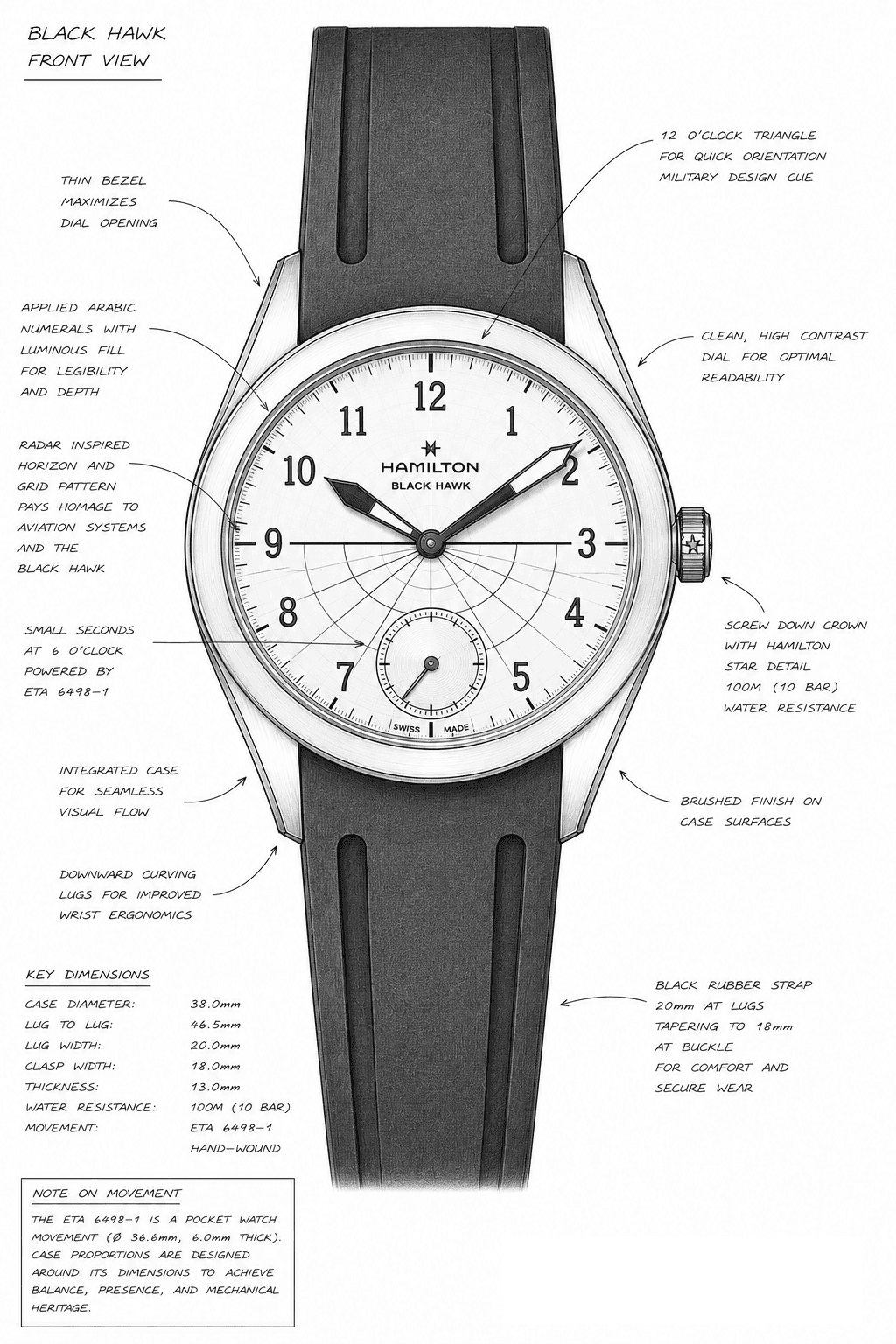
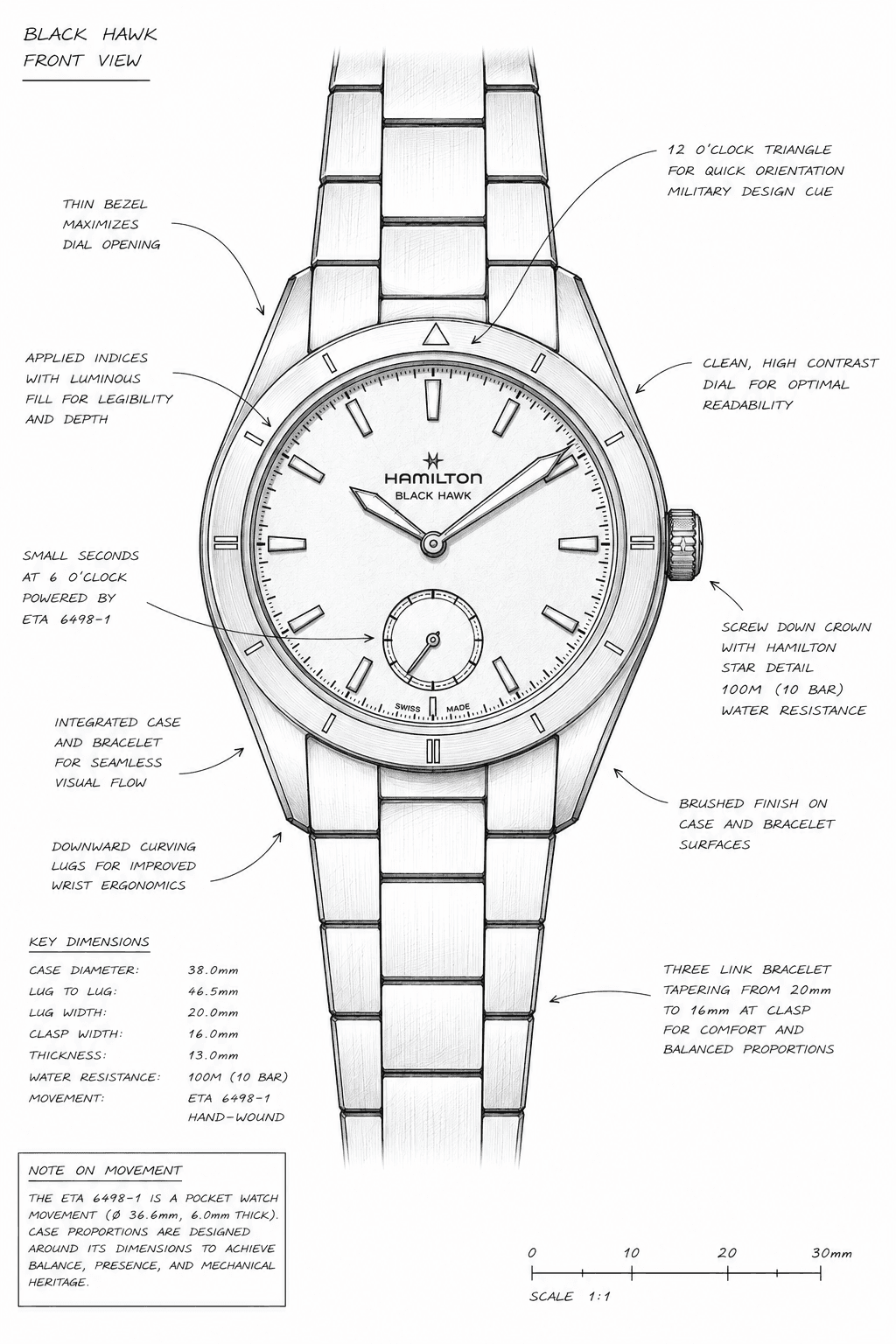
The guiding philosophy behind the Black Hawk project was “Function Creates Identity.” Rather than starting with purely aesthetic ideas, the design process began by establishing the watch’s engineering foundation. The dimensions of the ETA/Unitas 6498-1 movement determined the overall packaging of the watch, influencing the case diameter, dial opening, crystal size, rehaut geometry, caseback construction, and the internal clearances required for reliable operation. By allowing the movement to drive the architecture, the design remained grounded in real-world manufacturing constraints from the very beginning.
With the core dimensions established, each component was developed individually while ensuring that every part contributed to a unified visual language. Throughout the process, decisions were guided by a commitment to simplicity, legibility, balanced proportions, mechanical honesty, and manufacturable geometry. Instead of adding decorative elements for their own sake, every feature was evaluated based on whether it improved functionality or reinforced the watch’s identity.
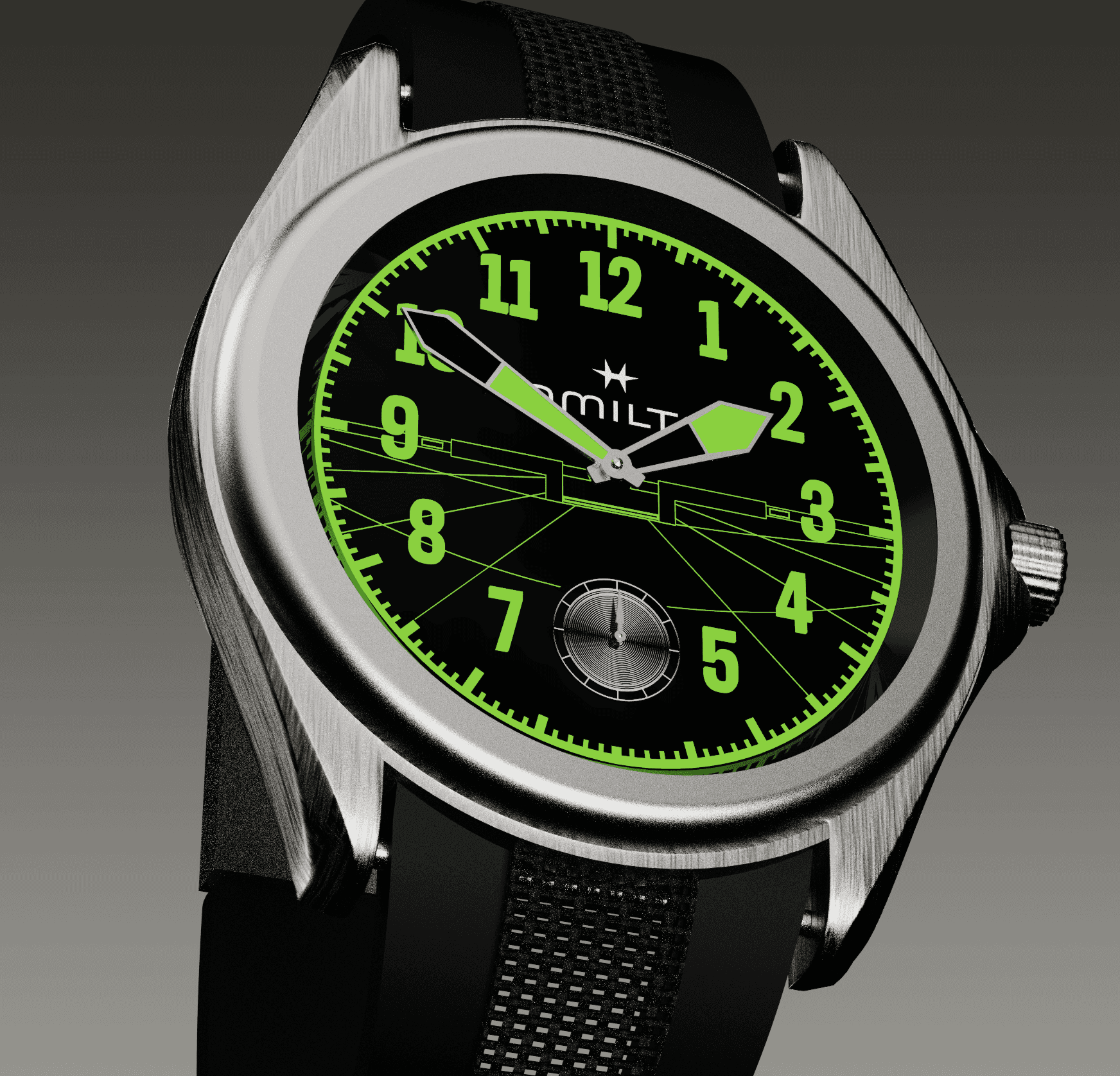
The final aesthetic reflects these principles through the use of black stainless steel, matte surface finishes, an anti-reflective sapphire crystal, bold pilot-inspired numerals, and a highly legible handset. Subtle aviation-inspired details reference the UH-60 Black Hawk without relying on literal graphics or excessive military styling. This restrained approach allowed the watch to capture the spirit of the aircraft through purposeful design, creating a product that feels authentic, timeless, and engineered for use rather than decoration.

Process and Solution
Process and Solution
The Black Hawk was developed using a traditional industrial design workflow that progressed from concept exploration to engineering, CAD modeling, and final visualization. The process was highly iterative, with each stage informing the next and requiring continual refinement as the design matured.
The project began with hand sketches exploring a wide range of dial layouts, bezel profiles, lug geometries, crown designs, and overall case proportions. As the concept evolved, each iteration became more focused, refining details such as numeral placement, hand proportions, bezel thickness, lug length, case profile, and overall dial balance. Elements that felt overly decorative or distracted from the watch’s purpose were gradually removed, resulting in a cleaner, more cohesive design that better reflected the disciplined engineering of the UH-60 Black Hawk helicopter.
Once the overall direction had been established, the design was translated into Rhino, where the watch was modeled as a complete assembly of individual components rather than a single solid body. The mid-case, bezel, sapphire crystal, rehaut, dial, hands, crown, caseback, bracelet, and movement components were all created separately to better replicate how the watch would be manufactured and assembled in reality. Throughout the modeling process, careful attention was paid to realistic tolerances, wall thicknesses, mechanical clearances, and the relationships between adjoining parts. Components were continually revised to improve both manufacturability and visual harmony, ensuring the final model was not only aesthetically balanced but also mechanically plausible.
Material selection played an equally important role in communicating the watch’s identity. The final design pairs a black stainless steel case with matte blasted and brushed finishes that evoke the rugged, low-reflectivity surfaces found on military aircraft. An anti-reflective sapphire crystal enhances legibility while preserving the premium feel expected of a mechanical timepiece, and metallic dial details provide subtle contrast without compromising the restrained aesthetic. Together, these materials reinforce the Black Hawk’s aviation inspiration while maintaining a refined, contemporary appearance suited to everyday wear.

The Results
The Results
The final Black Hawk concept successfully transformed the engineering philosophy of the UH-60 helicopter into a modern mechanical wristwatch.
Rather than relying on literal military imagery, the watch communicates its inspiration through disciplined proportions, restrained detailing, and purposeful construction.
The project demonstrates a complete industrial design workflow, from research and concept development to engineering, CAD modeling, materials selection, and final visualization.
Beyond producing a finished concept, the project strengthened skills in:
user-centered design
iterative problem solving
CAD modeling in Rhino
technical drafting
dimensional planning
mechanical packaging
material selection
photorealistic rendering
manufacturing-aware design
The Black Hawk ultimately represents more than a watch concept—it serves as a study in translating the values of an iconic aircraft into a functional, manufacturable consumer product while maintaining a clear and consistent design language throughout the entire development process.

Next projects.
(2016-2025)